

The U.S. tax code is rigged to favor wealthy individuals and corporations over workers. President Trump’s signature legislative accomplishment, the One Big Beautiful Bill Act, further rigged the tax code in favor of special interests while putting workers and families at tremendous disadvantage. This is done by taxing income from labor (wages and salaries) at a significantly higher rate than income from capital (dividends and investment gains). Thus those who work a real job for a living are paying effectively more than super-rich and intergenerational wealthy who can pay next to nothing on passive income. This disparity forgoes hundreds of billions of dollars in potential tax revenue that could be going to invest in public programs for the honest American working family.
Workers are Taxed at a Higher Rate than Wealthy Owners: A truck driver who puts in 40-hours work weeks to make $50,000 a year pays about $3,800 in federal income tax for an effective rate of 8%; but a lazy investor earning $50,000 in long-term capital gains and dividends would pay $0 in taxes. This disparity becomes worse the higher you go up the income scale. The top income tax rate on wages and salaries sits at 37% nearly twice the top tax rate on capital gains which sits at just 20%, rewarding wealth over work.
Wealthy Pay Less Than You In Social Security Taxes: The Treasury Department reported that the top 1% of households made $4.5 trillion of income but contributed just $103 billion to social security and medicare, an effective payroll tax rate of just 2.3%. Meanwhile working class families contributed on average nearly 9% of their income in payroll taxes. This is because the federal payroll tax is arbitrarily capped at just the first $185,000 of income.
The Rich Hide Their Income as “Unrealized Gains”: Billionaires and other members of the hyper-wealthy class main source of income is the rising value of their stocks, real estate and other investments they don’t sell. But they don’t need to sell to benefit. At those upper levels of wealth, they can obtain low-cost loans against their rising portfolios and live tax free. Whatever interest they pay on the loans is tiny compared to the tax they would owe if they sold their winning investments. And when those market gains are passed along to the next generation, they disappear for tax purposes. This tax-avoidance strategy is called “Buy, Borrow, Die”.
Corporations Don’t Pay Their Fair Share: American Corporations are paying the lowest effective tax rate in over a century. Last year’s Trump-GOP tax law handed corporations three big tax breaks that together will cost almost $600 billion in lost tax revenue, money that goes straight into the pockets of wealthy shareholders. For every $100 dollar in tax cuts to corporations, $75 of it goes directly into the pockets of the wealthiest 5% of households and foreign investors.
Corporations Use Tax Breaks to Offshore Jobs: The tax code promotes the offshoring of jobs by taxing the foreign profits of U.S. corporations at a lower tax rate than the tax rate on domestic earnings. These lower rates were set to expire, but were instead made permanent thanks to the Trump-GOP tax law. It is time we no longer subsidize corporations that use the tax code to fire hardworking Americans.
Americans for Tax Fairness’s overall policy agenda sets a revenue target of $10 trillion over the next 10 years by raising revenue from multiple different sources.
Microsoft Case Study:
Last year Microsoft was ranked as the 11th largest publicly traded corporation in the United States. In 2025 their domestic pre-tax income jumped by over 50% from the year prior — $65 billion to $101 billion — a record breaking profit for this tech giant. The CEO of Microsoft Satya Nadella was rewarded with a $96 million executive pay package, a healthy 22% pay increase from the year prior, while the median Microsoft worker saw their wages grow by less than 4% over the same period according to Microsoft’s own public financial disclosures.
Not only was Microsoft not sharing their explosion of profits with their workers, they also paid next to nothing in federal corporate taxes. Microsoft paid an effective tax rate of just 2.4%, down substantially from the 21% rate they paid in 2024. This low rate is due in no small part to generous federal tax credits. The federal government gave $1.5 billion to Microsoft “research and development” at a time when the company is bragging about cutting thousands of jobs thanks to their research and development into AI. Effectively our tax dollars are being used to subsidize the firing of American workers.
So if not to the workers where are the profits going? Microsoft showered their investors with $26 billion of dividends and $22 billion dollars of stock buybacks in 2025, the equivalent of over 4 million Microsoft workers salaries.
Workers Are Taxed at a Higher Rate Than Wealthy Households & Corporate Executives
Income earned from wages is consistently taxed at a higher rate than comparable amounts of income earned passively through capital gains or dividends. The top federal marginal tax rate on long-term capital income is 23.8% while the top marginal ordinary income and payroll tax rates on wages is 40.8%.
According to the Joint Committee on Taxation (pg 41) the average marginal income and payroll tax rate paid on labor income is 27.6%, while the average marginal tax rate on capital gains is just 21.8%.
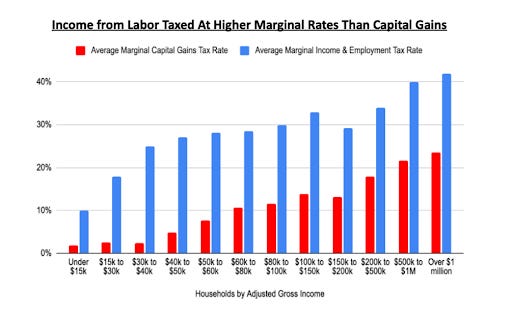
Source Joint Committee on Taxation
However, this labor vs. capital tax disparity actually understates the differential. In fact, 75% of the benefits from the reduced tax rate on capital income goes to the top 1% of households. Households with over $1 million of income receive 70% of long-term capital gains, but only 8.5% of ordinary wages, while households with under $200,000 of income earn just 7% of all long-term capital gains but 56% of all ordinary wages.
Example 1: A single person working for $17/hr. as a cashier makes about $35,000 a year. This person would pay about $2,200 in federal income tax and $2,700 in employee-side federal payroll taxes for an effective rate of 14%. A person making $35,000 in just long-term capital gains or dividends would pay $0 in taxes.
Example 2: A single teacher with one child making $70,000 a year would pay about $3,400 in federal income tax and $5,400 in employee side federal payroll taxes for an effective rate of 12.6%. A person making $70,000 in just long-term capital gains or dividends would pay $0 in taxes.
Example 3: A married doctor with two children making $300,000 a year would pay about $47,100 in federal income tax and $15,300 in employee side federal payroll taxes for an effective rate of 20.8%. A family making $300,000 in just long-term capital gains or dividends,would pay just $28,400, an effective rate of 9.5%.
Workers Don’t Benefit From Corporate Tax Breaks
After the enactment of the 2017 Trump-GOP tax law—which lowered the corporate tax rate from 35% to 21%—corporations now pay on average a lower effective income-tax rate than the average American family for the first time in nearly a century.
It is estimated that for every $100 Congress spends on corporate tax cuts, only $10 trickles down to the bottom 80% of American households, while $40 goes to foreign investors, and $17 goes to the top 1% of highest-income households.
Corporate tax cuts are a very inefficient way to grow the American economy compared to directly investing in workers. CBO projects that on average the increased economic output generated from $1 of corporate tax cuts it just 20 cents. Conversely, $1 of direct payments to working families—such as a refundable monthly child tax credit—yields $1.25 of increased economic output on average.
The top 0.1%—the highest-income 200,000 households—saw their effective corporate income-tax rate (the share of corporate taxes economists estimate individuals pay for) drop from 10.5% in 2015 to as low as 5% in 2019. The bottom 50 percent of households saw essentially zero tax benefit from the Trump-GOP corporate-rate cut.
While corporate profits have grown 59% since 2015, Treasury projects the increase in federal revenue in 2024 coming from the top 0.1% of households, who own a disproportionately large share of corporate equity, will be negligible.
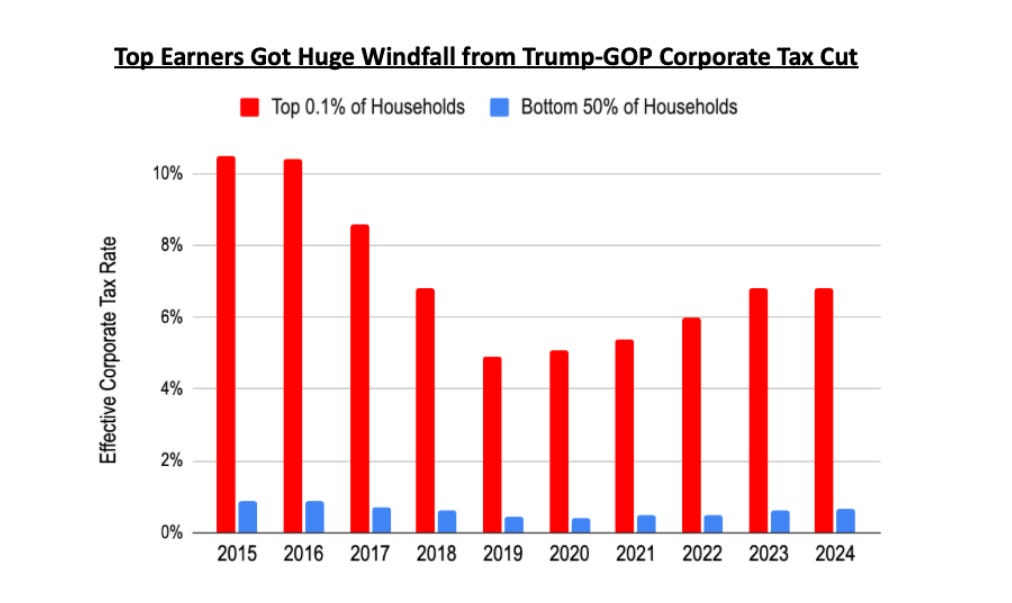
Source Office of Tax income Analysis
While wealthy corporate owners reap billions from the Trump-GOP tax law, hardworking union members of those corporations can no longer deduct the cost of union dues. If Congress were to consider reinstating a tax deduction for union dues, it would only require a 0.1% increase in the corporate tax rate to fully pay for it.
Policy makers should also prevent corporations from using tax breaks to suppress workers organizing to form or join a union, or bargain for better wages and benefits, by passing the No Tax Breaks for Union Busting Act. This legislation would ensure businesses could no longer claim tax deductions for interfering with unionization campaigns, such as spending on so-called “captive audience meetings” and million dollar anti-union advertising campaigns deployed in union elections or organizing campaigns. It is estimated that employers spend at least $400 million trying to hinder or inhibit union organizing efforts each year. The bill also establishes an IRS reporting requirement for employers who intervene in protected labor activities.
International Tax Law Incentivizes Corporations To Move U.S. Jobs & Profits Overseas
The global tax system has long allowed U.S. corporations to avoid paying their full amount in domestic taxes by shifting their profits overseas to tax havens like the Cayman Islands and Bermuda. In 2018 and 2019—after the Trump-GOP tax law was supposed to have curbed offshoring—U.S. multinationals reported 61% of their foreign income from just seven offshore tax havens.
Corporate profit shifting is expected to cost the federal government $60 billion a year in lost revenue annually. The tax code actually encourages this practice because the foreign profits of U.S. corporations are taxed at around half the rate of their domestic earnings and is riddled with numerous loopholes that incentivize shifting production overseas.
One of the most notorious loopholes created under the Trump-GOP tax law was the “Foreign-Derived Intangible Income” (FDII) deduction, which perversely encourages American corporations corporations to move jobs and investment abroad by offering a huge tax break to export sales over 10% of domestic tangible assets. Eliminating this loophole would generate up to $224 billion in additional revenue over 10 years.
Policy makers can level the tax playing field by passing the No Tax Breaks for Outsourcing Act (S.357/H.R.884) which would eliminate the deep discount that multinational corporations get for shifting profits offshore and outsourcing jobs by raising the U.S. tax rate on foreign profits from 10.5% to 21%. Critically, this bill would also change how taxes on the foreign profits of multinational corporations are calculated from a global average to a country-by-country basis, stopping companies from dodging taxes by using subsidiaries in low-tax countries.
Decades of Trickle Down Tax Cuts Hurt Workers By Jeopardizing Key Federal Programs
Republican tax cuts have failed to boost job growth or wages. In the two years immediately following the 2017 Trump tax law (before COVID) worker wages and corporate hiring actually grew more slowly than under the last two years prior to the law’s enactment.
After slashing taxes for the very rich, Republicans often immediately pivot to using the ballooning deficits they created as an excuse to force through draconian cuts to public services or programs for working families. Examples include:
From 2010 to 2021, when Republicans controlled at least one chamber of Congress, annual funding for the National Labor Relations Board dropped from (an inflation adjusted) $352 million to just $274 million, a real-dollar cut of 22%. That means fewer NLRB staff assisting with union elections, overseeing disputes, and holding corporations to account for unfair labor practices.
From 2010 to 2021, the Labor Department’s Job Corps—the largest free residential education and job training program for young adults—saw its funding drop from $2.19 billion to $1.75 billion, a real dollar cut of 20%.
From 2010 to 2021, the Equal Employment Opportunity Commission—which is tasked with enforcing civil rights laws against workplace discrimination—saw its funding drop from $456 million to $404 million, a real dollar cut of 11%.
Republican tax cuts—that have mostly been slanted to the wealthy—have been the primary driver of federal debt this century, costing the Treasury more than $10 trillion since 2001. These series of tax handouts to the ultra-wealthy have helped exacerbate wealth inequality, with the richest top 0.1% of households growing their wealth by 400% since 2001 while the bottom 50% of households saw their wealth grow by less than half that rate (180%) during that same period.
Every dollar spent on tax cuts for the rich is a dollar not being used for much-needed public services that lift working families up.
Extending the estate tax policies in the Trump-GOP law would cost over $170 billion over the next decade and would only go into the pockets of the richest 0.2% of households. For that same amount of money Congress could; 1) expand access to public housing for over 1 million families; 2) provide 12 weeks of maternity leave for over 1.8 million working mothers; or 3) give free pre-k to over 1.3 million children.